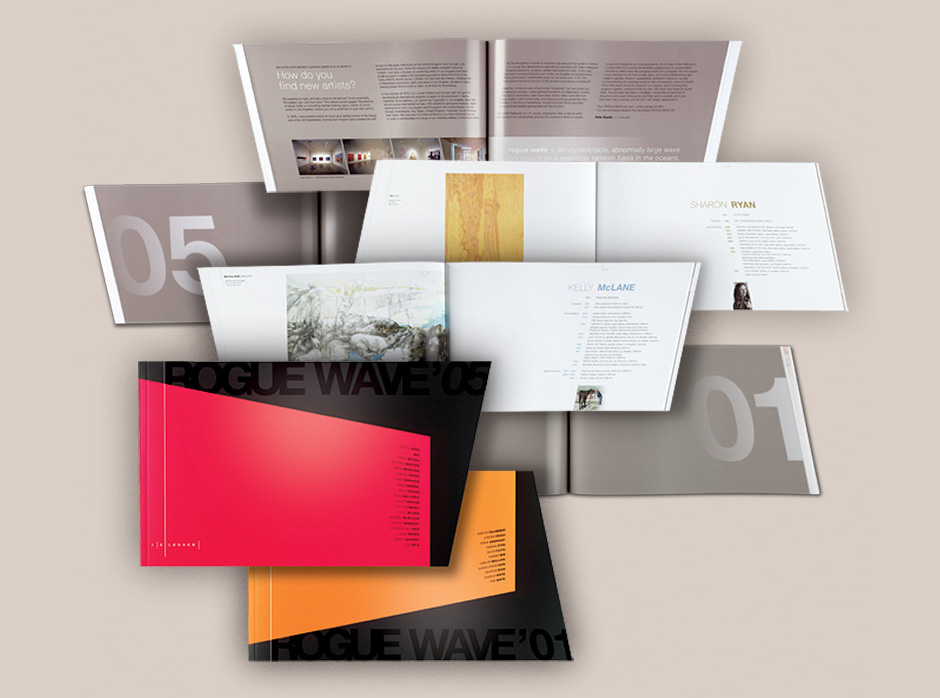
Here’s your argument for reading the classifieds: I answered an ad in the Art Center alumni bulletin and about six months later, the nice folks at the L.A. Louver gallery called on me to build them a catalogue documenting their 2001 and 2005 Rogue Wave exhibits of contemporary Los Angeles artists.
The catalogue is a marvel of print production: You got your fluorescent inks on the cover. You got your titles printed in spot varnish. You got your rakish 12° angle cut on the face. The whole thing is printed using stochastic screening for image clarity that’ll make you weep with geek delight. (Using a loupe, you can see the highlights on individual brush strokes with sharp definition. It’s something else, this stuff.) Did I mention that the book works from both sides to give both shows equal billing?
Yes, if you ever felt like making life difficult for your printer, this is a good start. I’m glad I had the dedicated printers at Typecraft in Pasadena on my side for this one. Moreover, I’m grateful that my clients at L.A. Louver extended me the trust and patience to produce a design that gives an uncompromising home to the brilliant pieces they selected for the exhibit.
It was a tricky job and taxed everybody’s good humor, but we came out with a cool piece. I hope the chosen artists will feel well represented.
As a backup, I had asked Marcia for a third option—a straightforward hardcover book, though of impressive size. Tarsem loved it. He signed off on the budget and handed me boxes upon boxes of photos. He gave me complete freedom to select and sequence the images as I pleased, which gave me license to step back into my American Photography frame of mind.
What was different in this case wasn’t just that I had more than ten times the images to work with, but that about half of them didn’t even come with contact sheets. After you’ve stared at negatives through a loupe for a few hours straight, looking at your e-mail inbox becomes mildly psychedelic. I was also editing half blind as far as the story was concerned. Tarsem had shown me a working version of the film. Whenever there was a black frame, he’d talk me through the missing scene. I remember my pupils dilating ever so slightly when he said, “and this is where the marionette sequence will go.” But as he’d already told me not to worry about matching my sequence to the plot of the film, I forged ahead.
When I showed him the finished running order a few weeks later, he was delighted! There were only a few substitutions he wanted to make. His assistant Stephanie called a few days later to set up a time for Tarsem to swing by my place to look at a few options. How much time should we schedule? “Tarsem seemed pretty happy overall,” I told her. “I think an hour and a half should be plenty.” He stayed for seven hours the first day, nine the second, and another four or five on the third. I scanned dozens of alternate images on the spot, and made printouts we could lay out on the floor. After all of it, he looked at the final selection and said, “Huh. That’s just about what you had, isn’t it? You really picked the good ones.”